
Town of Rotterdam Directory Holdings
The documented collection is not presented as a Rotterdam-only city-directory run. The strongest shelf is the Schenectady County Public Library collection, which is chiefly for Schenectady but can include other county localities. Confirm the locality scope inside each volume before treating a Rotterdam address as covered. The library holds the early 1841–42 and 1857–58 directories, then a long run from 1861 through 1968. The holdings page is the best starting point because it identifies the gaps instead of suggesting an unbroken series.
| Collection | Years | Where Held | Access |
|---|---|---|---|
| Schenectady city directories | 1841–42; 1857–58; 1861–1968 | Schenectady County Public Library | In-library reference; inspect each volume’s locality scope |
| Street-address sections | 1930 onward within the directory run | Schenectady County Public Library | Use address order after locating a street and number |
| Cross-reference directories | 1967; 1971 to the holdings-page date; Colonie-Schenectady 1980 and 1984 | Schenectady County Public Library | Onsite address-to-occupant or business research |
| Telephone books | 1961 and later holdings | Schenectady County Public Library | Onsite local-history reference |
| Digitized directory pages | 1841 and 1860 links | Schenectady Digital History Archive | Free online HTML and image browsing |
The named gaps in the 1861–1968 run are 1903, 1917, 1922, 1932, 1934, 1944, 1946, 1948, 1950, and 1967. SCPL reports no city directories for 1968–2006. That absence does not settle whether a person left Town of Rotterdam. It calls for another dated source, such as a telephone book, cross-reference volume, census, tax roll, map, church record, or newspaper.
The SCPL directory-holdings page is the source for those years and omissions.
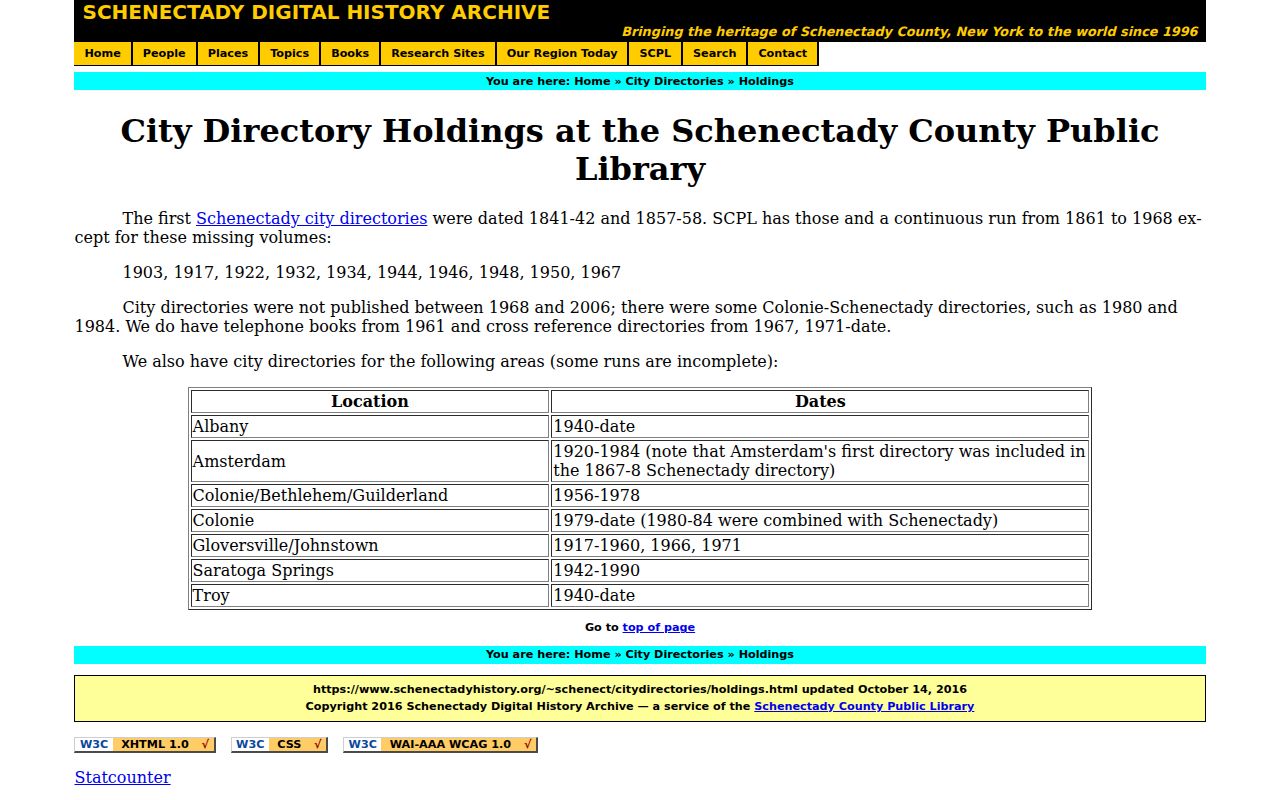
Use the holdings list to select a real volume before planning a library visit or drawing a conclusion from a gap.
Town of Rotterdam’s 1841 Directory
The earliest digitized local volume inspected is Schenectady, New York Directory and City Register for the years 1841-2, printed by J. & W. H. Riggs at 23 Union-Street. It describes itself as an alphabetical arrangement of heads of families, firms, and people doing business in the city, with their business role and place of residence. That wording matters for Rotterdam research. It is a Schenectady city directory, not proof that every Town household was included.
The digitized 1841–42 directory offers letter tabs A through Z, plus Streets, Businessmen, Clergymen, Union College Faculty, government officials, advertisements, images, and history. Browse rather than expect a modern full-text database. Its introduction says the first attempt could be imperfect or erroneous, so surname variants and nearby entries deserve a check.
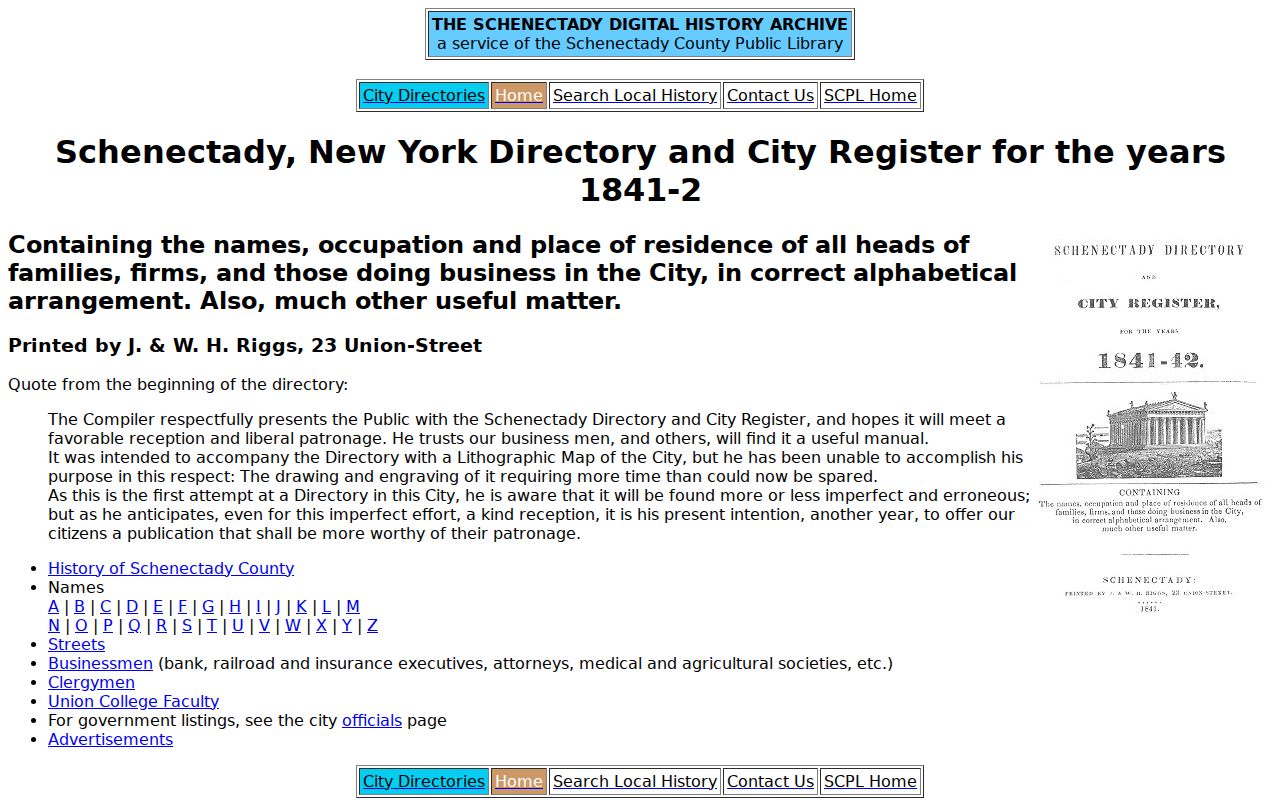
The visible tabs make it practical to test a surname, a street, and a business category separately before moving to a printed volume.
Reading Rotterdam Directory Entries
An entry is a dated pointer, not a biography. In the digitized 1841–42 volume, the visible structure is an alphabetized name, a business role or activity, and a place of residence. Separate indexes collect selected business, civic, religious, and college categories. Later books may use different abbreviations and layouts. The inspected early sample does not show modern spouse-in-parentheses, owner or renter indicators, or widow notation, so those meanings should never be assumed from a later book without its own key.
| Alphabetized name | The primary finding path in the 1841–42 volume. |
|---|---|
| Business role | A stated trade or firm connection, when printed. |
| Residence | The address or place of residence printed for the entry. |
| Special indexes | Businessmen, clergymen, Union College faculty, officials, and advertisements appear separately. |
| Later notation | Read the front matter and abbreviation key in that exact volume before interpreting a mark. |
- Criss-cross directory
- An address-first directory arranged to move from a street and number to the listed occupant or business. SCPL records later cross-reference volumes separately.
- Householder index
- An alphabetical name list used to locate a listed individual or head of household. The 1841–42 scope is limited to the people its introduction says it set out to include.
- Abbreviation key
- The volume’s own explanation of shortened marks. Check it before carrying any notation into a family record.
Rotterdam Streets After 1930
The historical society’s house-history guide says city directories added a street-address section beginning in 1930. This changes the research route. A name directory begins with the person and produces an address. A street section starts with the address and can identify a listed occupant or business. The two paths should be compared, especially when a family moved within the same corridor or a surname appears in several entries.
Before 1930, a Rotterdam address may require an alphabetical search, a usable street section, a volunteer-created early street listing, or a head-of-household identified through a name and business-role clue. The modern property workflow belongs with the Town of Rotterdam street directory; historical sections are best used to establish an earlier dated layer of the address.
Town of Rotterdam Archive Records
Directory research has a second shelf at the Schenectady County Historical Society’s Grems-Doolittle Library. Its collections include local histories, genealogies, diaries, newspapers, yearbooks, wills, naturalization records, maps, photographs, family papers, and records of schools, businesses, churches, and organizations. The library’s resident-oriented indexes include the 1865 New York State Census index, an obituary index with more than 5,000 entries, Jonathan Pearson Street Books around 1870, and the VB 79 real-estate ledger for 1870–1880.
Grems-Doolittle is at 32 Washington Avenue in Schenectady’s Stockade Historic District. Visits are by appointment. Contact librarian Marietta Carr at librarian@schenectadyhistorical.org or 518-374-0263 ext. 3 at least two business days ahead and send a list of items to be pulled. Staff and volunteers can also conduct research on request.
The historical society collections page describes the catalog, NY Heritage material, Empire ADC finding aids, County History Forge, maps, and photographs.
Those collection-level routes are useful when a directory name needs support from an obituary, map, deed reference, or family paper.
Rotterdam Junction Directory Clues
Town of Rotterdam is made up of hamlets and corridors, not one compact downtown. Rotterdam Junction, South Schenectady, Pattersonville, Carman, West Hill, Dunnsville, and Plotter Kill can all affect how a place is described. The Town formed in 1820, while the Erie Canal opened in 1825 and railroads later shaped local movement. A person may therefore appear in a Rotterdam Junction source and a Schenectady directory in nearby years without that alone proving two different households.
For Rotterdam Junction, the house-history guide identifies a 1913 Sanborn sheet. Sanborn maps are structure and address evidence, not lists of people. Pair one with a directory address, then compare the 1856 county map, the 1866 county atlas, census schedules, newspapers, and the Pearson Street Books. The same careful approach applies to the Putman and Putnam spellings near Phillips and Princetown: the Town history relates a sign-painter account, but each spelling still needs support from a map, deed, cemetery record, obituary, or family paper.
Rotterdam Directory Timeline
Publication and access did not move in one smooth line. The following landmarks help set reasonable expectations for a Town of Rotterdam city-directory search.
| 1841–42 | Earliest digitized local directory inspected, printed by J. & W. H. Riggs. |
|---|---|
| 1857–58 | Another early SCPL-held directory volume. |
| 1861–1968 | SCPL’s long run, with the named missing years listed in the holdings section. |
| 1930 | Street-address sections begin in the directory series described by the historical society guide. |
| 1961 and later | Telephone-book holdings at SCPL. |
| 1967; 1971 onward | Cross-reference-directory holdings, alongside limited Colonie-Schenectady 1980 and 1984 volumes. |
| 1968–2006 | No city-directory run reported by SCPL. |
Dates resolve a common false lead. An online result can point to an historic index or an image, while the physical directory, a census reel, or an archival map may be the source that supplies the missing context.
Tracing Town of Rotterdam Directory Households
Use the directory as a dated checkpoint in a family-history trail. A name can be misspelled, a town address can be represented through Schenectady, and a missing volume can interrupt a sequence. Compare the address line and business role first, then move through the next available book. Census schedules add household composition, while deeds, probate, obituaries, cemetery records, church material, tax rolls, and maps answer different questions about the same place.
- Find the earliest available name entry and record the spelling, business role, and residence exactly as printed.
- Move to the next available directory year, noting address changes and gaps in the run.
- For years with a street-address or cross-reference section, check the address from the name entry.
- Pair the dated entry with the 1860 and 1865 state census, then the 1870, 1880, 1900, 1910, 1920, 1930, 1940, or 1950 federal schedule as the period requires.
- Use a deed, probate file, obituary index, cemetery record, church record, tax roll, map, or newspaper to test why the sequence changes.
A disappearance from a city directory can mean a move, death, changed listing practice, locality mismatch, an unscanned volume, or simple omission. SCPL holds federal census microfilm for Schenectady County from 1790–1930 and most New York State and federal census microfilm, indexes, transcriptions, and subscription databases. For a modern confirmation after historical research, use the records appropriate to one person through the Town of Rotterdam resident lookup route rather than treating an old printed name as current evidence.
Town of Rotterdam Directory Research
SCPL Central Library supplies the broad local-history layer: city directories, high-school and college yearbooks, county census microfilm, atlases, government records, and newspapers reaching back to 1822. Central Library-only Ancestry access, Historical New York Times from 1851–2017, America’s News for library-card users outside the library, and the NYSDOH Genealogical Research Death Index for 1957–1972 can help corroborate a dated directory entry. The Efner History Center at Schenectady City Hall is another comparison point when an address or source is described as Schenectady.
The SCPL genealogy and local-history resources page identifies those collections and access modes.
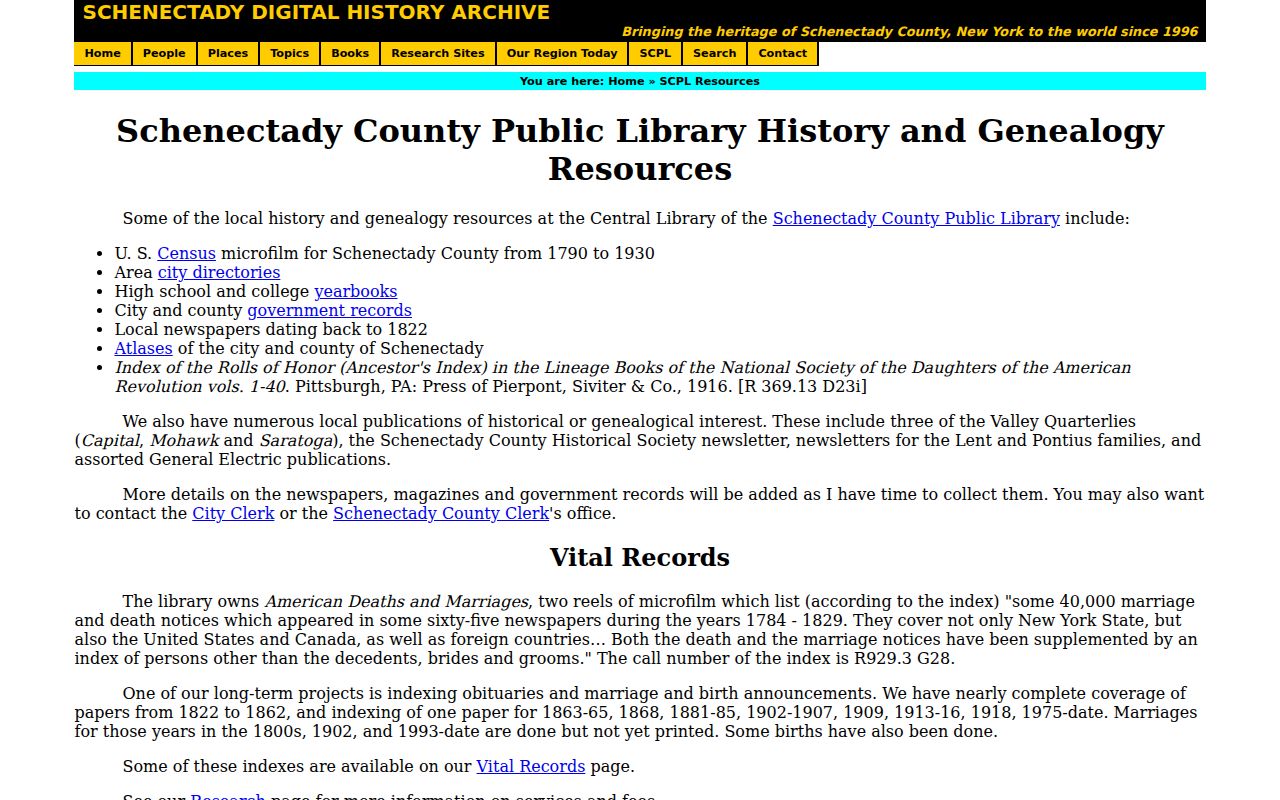
Use the library catalog and a librarian’s help to distinguish a printed directory, a microfilm source, a licensed database, and an archival finding aid before requesting material.