
Town of Rotterdam Previous Residents by Era
Previous residents are best traced through an address history that separates ownership from occupancy. The Town Assessor and its PROS system establish the current parcel clue. The County Clerk’s recorded documents carry the ownership trail. Directory street sections, census schedules, maps, and probate materials can then add the people and structure history around that parcel. Coverage differs by record set, so a blank result in one source should move the search to the next layer rather than close the inquiry.
| Source | Years It Covers | Where Held | What It Shows |
|---|---|---|---|
| PROS and Town assessment rolls | Current system; 2025 and 2026 rolls were identified | Town of Rotterdam Assessor | SBL, situs, owner field, assessment, and parcel inventory. |
| Recorded deeds in SearchIQS | Public online start or cutoff not located | Schenectady County Clerk | Parties, dates, legal description, and images when available. |
| Street sections and cross-reference directories | 1930 onward for street sections; cross-reference holdings from 1967 and 1971 | Schenectady County Public Library | Address-to-name leads, subject to missing volumes and locality scope. |
| Directory collection | 1841–42, 1857–58, and 1861–1968 with named gaps | SCPL and digital archive | Names, occupations, residence lines, businesses, and selected street aids. |
| Maps and VB 79 | 1856, 1866, 1870–1880, and Rotterdam Junction 1913 | Grems-Doolittle Library | Landowner, parcel, structure, road, or real-estate clues. |
| Probate microfilm | 1809–1901 wills | Grems-Doolittle and Surrogate’s Court | Decedents, executors, devisees, and possible property links. |
Use the current parcel first when the address is known. If the period is recent, the deed chain is usually the next step. For a nineteenth-century question, maps, VB 79, and probate may supply a bridge before a complete chain can be reconstructed. Occupancy and ownership can diverge, so each finding should be labeled by its record type and date.
Town of Rotterdam SBL Records First
The Tax Map number, often called an SBL, is the durable starting key for a Rotterdam house history. In the Town’s PROS search, the physical property location and the owner’s mailing address are separate fields. Enter the street number and name without its suffix, or use the Street Finder. Save the SBL, situs address, owner field, assessment year, and access date before looking for earlier records. A postal city or mailing address can change while the parcel key gives the County Clerk and map sources a stable point of comparison.
The PROS quick-search form supports Street Address, Tax Map # or SBL, Owner Name, and Street Finder. It also allows partial address text. The owner field can be a lead to a deed, but it does not establish that the named owner lives at the property. A parcel card is assessment information, not a title opinion.
Note: Preserve the printed SBL exactly, because a guessed lot or block number can break an older-property search.
Town of Rotterdam SearchIQS Records
The Schenectady County Clerk’s land-record route leads to SearchIQS for party and date work. The County’s public-search guide documents Party 1 and Party 2 fields, an option to ignore party type, date ranges, sortable results, document view, related-document links, and a “My Documents” basket. A partial first name can return more candidates. The asterisk wildcard may stand for unknown letters, which helps when an older index contains a spacing, punctuation, or spelling variation.
In the result grid, a View entry marked with an asterisk indicates that images are available. Document view can show indexing data, images, and related documents. The guide also warns that an “UNVERIFIED Document” remains unverified until indexing is confirmed, with unverified dates shown in red. Treat that label as a reason to inspect the record closely, not as a final statement about title.
The County Clerk land-record page is the official entry point, and its SearchIQS public-search guide supplies the documented field behavior. The public sources did not state a complete online starting year or cutoff year, so an online miss is never proof that a deed was not recorded.
Town of Rotterdam Previous Residents Deed Chain
To trace past owners, use today’s parcel data only as the first link. Find the current owner’s acquisition deed in the County Clerk index, read the seller or grantor, and then search that seller as a grantee to locate the earlier purchase. Repeat the move from later deed to earlier deed while comparing the legal description, parcel clues, and recording date. A legal description identifies the land conveyed and is usually more dependable than a street label in older records.
- Open PROS for the situs address and record the current SBL, property location, and owner field.
- Search the owner in SearchIQS, then use date and document clues to identify the acquisition instrument.
- Read the seller named in that instrument and search the seller as a grantee for the earlier acquisition.
- Compare each deed’s legal description with the parcel and with adjacent records before joining it to the chain.
- When the online results no longer reach the needed period, move to the County Clerk counter, historical materials, or the appropriate microfilm route.
- Grantor
- The party transferring an interest in a recorded instrument, commonly the seller in a deed.
- Grantee
- The party receiving that interest, commonly the buyer. Searching a prior owner as grantee often finds an earlier purchase.
- Chain of title
- A dated sequence of recorded transfers used to follow ownership of the same land backward.
- Legal description
- The parcel wording in an instrument. It helps distinguish land when a road name or number is uncertain.
Town of Rotterdam Deed Records at the Counter
The public documentation does not give SearchIQS a complete online index cutoff. That gap matters for older deeds and for any result chain that stops abruptly. The County Clerk at 620 State Street is the direct fallback for land-record and index questions. For a focused request, provide the municipality, street address, SBL, party names, document type, and date span. Ask what can be inspected at the counter or copied, rather than asking the office to create a history that it does not maintain.
Older material may also require a library or historical-society route. The house-history sources include deeds, maps, ledgers, and probate microfilm, and the County Clerk remains the custodian for recorded instruments. A County map or historical deed listing can point to a volume, but it should be followed to the original record where possible.
Note: A failed online deed search may indicate an unscanned period, a spelling variant, or a different index path.
Town of Rotterdam Building Map Records
Maps answer a different question from deeds: whether a structure or landowner clue fits the address and time period. The Grems-Doolittle house-history guide identifies an 1856 county map, an 1866 Schenectady County atlas, the address-indexed VB 79 real-estate ledger from 1870–1880, Jonathan Pearson Street Books, and a Rotterdam Junction Sanborn sheet from 1913. The Sanborn sheet can show a building footprint, material, use, and street context. It is not an occupant list.
The Grems-Doolittle Library offers the collections through appointment and research-request channels. Its holdings make an important physical fallback when the web index cannot establish an address change or when a deed description needs local map context.
The library route is particularly valuable for house history because maps, wills, directories, and historical indexes can be compared in one local collection.
Town of Rotterdam Past Resident Households
Ownership is only one part of an address history. Schenectady directory volumes list names, occupations, and residence lines, while later volumes include a street-address section beginning in 1930. SCPL reports a largely continuous run from 1861 to 1968, with named missing years, and it holds cross-reference directories from 1967 and 1971 onward. The volumes are mainly Schenectady-focused, so check each volume’s locality scope before treating a Rotterdam address as included.
The Schenectady Digital History Archive directory collection supplies digitized directory access and identifies street-listing material. It is a starting point for a dated household lead, not proof of every person at an address.
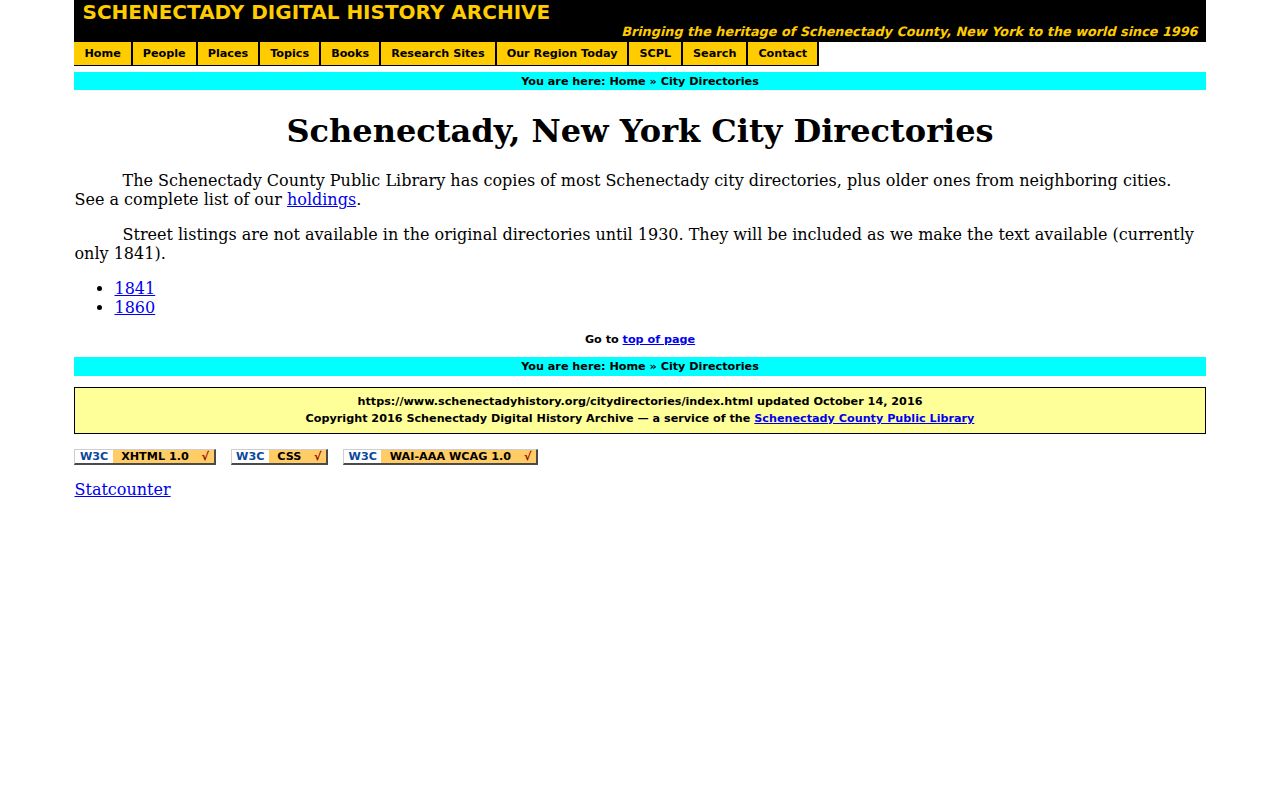
Use the street material beside the alphabetical entry, then carry the name and year into census, deed, obituary, or probate sources as appropriate.
Town of Rotterdam Directory Records Pairing
Pairing a directory year with a census year can make past-resident research more reliable. Federal census schedules through 1950 are public under the National Archives’ 72-year rule, and SCPL has Schenectady County federal census microfilm from 1790–1930 along with many state and federal census sources. A directory supplies an address and often an occupation. A census can add household relationships, ages, tenure status, and other time-bounded context.
- Find the nearest available directory entry or street section for the address and write down its publication year.
- Check the matching or nearest census schedule for the head of household and compare the address context carefully.
- Move to the next available directory volume, keeping the known gaps in the collection in mind.
- Use a deed, obituary, cemetery record, or probate file to test a move, death, or transfer suggested by the household sequence.
The deeper directory collections are maintained on the Town of Rotterdam Directory Book page. For an address history, use those volumes as dated evidence rather than as a substitute for the recorded parcel chain.
Town of Rotterdam House History Uses
A careful address history can help a family connect a building to its past without making claims about present occupants. In Rotterdam, the useful local combination is a parcel key, recorded deed, map, directory, and dated household source. Rotterdam Junction has a 1913 Sanborn sheet, and the Grems-Doolittle guide connects Rotterdam work with building inventory forms, maps, directories, wills, census material, and VB 79.
Those sources can answer modest, evidence-based questions: whether a structure appears on a map, who held a recorded interest, or how an address was printed in a given year. Keep each conclusion tied to the source date. For a place near the canal or railroad corridors, compare the 1856 map, 1866 atlas, newspaper, and Pearson Street Books before turning local color into a property conclusion.
Town of Rotterdam Address Record Changes
An old address can fail because the road, postal city, rural route, or number format changed. Rotterdam’s eCode has a Streets, Naming and Numbering chapter, but no complete official historical renumbering crosswalk was located. Compare the SBL, road name, map, directory street section, Sanborn sheet, and neighboring parcels instead of assuming the modern number is printed the same way in every era. The 1841 directory is city-focused and should not be used as a complete Rotterdam reverse index.
The Town history also supplies a cautious spelling example. A Putman family farm near Phillips and Princetown appears as “A. Putman” on an 1866 map. The Town says a sign painter may later have altered the spelling to Putnam, which was repeated on signs and addresses. Search both spellings only as a hypothesis, then verify with the map, deed, cemetery, obituary, and family papers. It is not evidence that every Putnam record belongs to the same family.
Rotterdam’s street naming and numbering code is the local lead for a present-day naming question. It does not supply the missing historical crosswalk.
Town of Rotterdam Probate Records
Probate can close a gap after a household leaves the address trail. Schenectady County wills on microfilm cover 1809–1901 through the historical collection, while the Surrogate’s Court at 612 State Street is the present court route for wills, estates, and letters of administration. Probate is person-indexed, so it usually needs a known decedent from the deed, directory, obituary, cemetery, or census work already completed.
Obituary indexes and local newspapers can add a date or family connection, but they should lead back to an original record or a clearly dated published notice. Records from before Rotterdam’s 1820 formation may also require an Albany County or broader Schenectady-area search. That jurisdiction change is another reason to record the exact source, year, and geographic description with every past-resident finding.