
Town of Rotterdam Resident Lookup Records
Match the record to the question. The Town’s property roll answers an assessment or parcel question. A court index answers a case question. A vital record fits a dated life event. Genealogy work leans on that kind of record. None of these is interchangeable. No single one lists every person living in Rotterdam.
| Record | What It Confirms | Where | Access |
|---|---|---|---|
| Property roll | Assessed owner, parcel and owner mailing address | Town of Rotterdam PROS | Free public portal |
| Voter registration | Registration or polling-place match at the time searched | NYS voter lookup | Limited self-service; statutory rules apply |
| Court index | Case number, parties, court, year and status where displayed | New York State eCourts | Free index; clerk copies may have fees |
| Vital records | Dated birth, death, marriage or divorce facts | NYSDOH and the Town Clerk | Copies and genealogy access are restricted |
| Public role records | Official title, entity status or license status | Town, NYDOS and NYSED sources | Public search varies by custodian |
Let the fact you already hold set the route. A known property address leads to the parcel owner and the SBL. A known year changes everything. Historical directories, obituaries, cemetery files and genealogy records suit that older question. Court questions go to the custodian’s own index. A resident lookup stands strongest when two independent records agree on the name, the year and the connection.
Town of Rotterdam PROS Checks
PROS takes a quick search by address, SBL, owner name or street-finder. Property and sales filters live in its advanced mode. An owner-name result returns a parcel identifier. It also shows the assessment roll’s Current Owner’s Address. Read the label carefully. It marks an assessed ownership connection, never every person living at the site. That gap matters when one person is the whole search.
A parcel can hold a situs address and a different mailing address. The mailing side may point to a trust, an attorney, a business, another residence or a tax-mail destination. Then try the Schenectady County Clerk’s deed index. The Town of Rotterdam Street Directory covers the address-based record path in more depth.
Town of Rotterdam Court Lookup
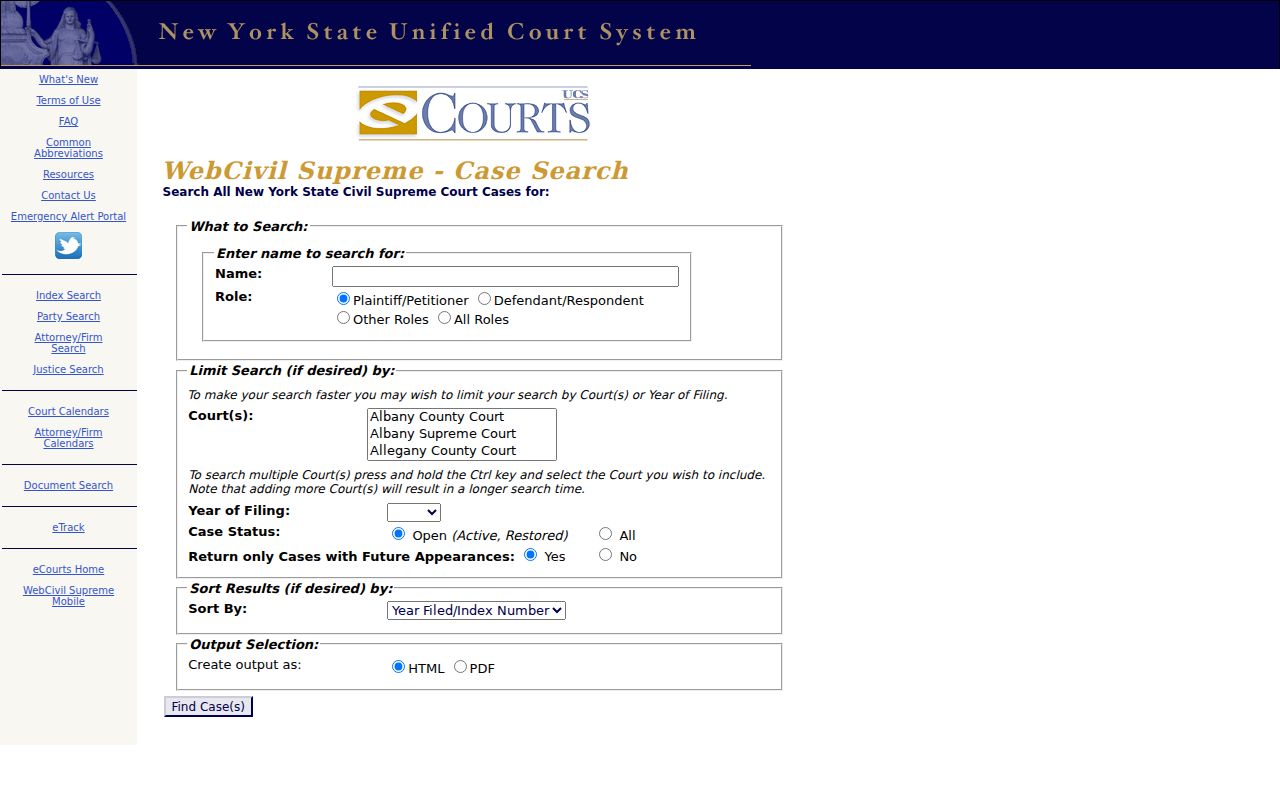
WebCivil Supreme handles civil Supreme Court questions. Its Index Number search starts from a case number. Name searches cover party, attorney and justice. Party results narrow by role, court selection, filing year, case status and future appearances, and they finish in HTML or PDF. The role choices include Plaintiff/Petitioner, Defendant/Respondent, Other Roles and All Roles. Coverage spans active and disposed Civil Supreme cases, not every Rotterdam Town Court file.
Every hit is an index entry. The case summary may show party name and role, index or case number, court or county, filing year or date, status, justice, and appearance or calendar details, with links where the system offers them. A full file is not promised. Run the exact name. Run a supported variant too. Before treating two similarly named people as the same person, compare the role, the court and the year.
The WebCivil Supreme party-search form displays the official fields for that civil lookup. Those fields come straight from the state courts.
Treat the index as a pointer. Ask the appropriate clerk for the public file, a copy or a certificate, since the web screen is rarely the complete record.
WebCriminal is narrower still. It demands the first two characters of both first and last name, or five for a corporation. Only selected criminal courts appear, and only pending cases or future appearances. The update notice warns that data can lag. Rotterdam Town Court has no public local name-search form. Its clerk is the fallback for a file or local docket.
Town of Rotterdam Voter Lookup
New York’s Poll Site Search, Voter Registration and Mail Ballot Tracker is a limited voter service, not a browseable resident roll. The tool asks a registered voter for last name, first name, date of birth in month/day/year format, county, ZIP Code and address information. Cookies and JavaScript are both required. Rotterdam searches call for Schenectady County. Handle the birth date with care. Never retain it or publish it after the search.
Registration information is public under supervision. Even so, Election Law § 3-220 excludes driver-license, non-driver-ID, Social Security and fax fields. A fuller voter-data request has a further elections-purpose requirement under Election Law § 3-103(5). The Schenectady County Board of Elections is the local route when the state tool cannot resolve an address. The county keeps its own retention and inspection rules. A match proves nothing about continuous or current residence.
Town of Rotterdam Vital Records
Birth, death and marriage records for the Town of Rotterdam run through two offices. The Rotterdam Town Clerk issues local certificates and handles marriage licensing. The New York State Department of Health keeps the statewide registry for events outside New York City. The Town page publishes no complete current name index. Call the Town Clerk before mailing payment for a local copy. If the event belongs to the statewide system, use the state process instead.
Genealogy research comes with firm limits. NYSDOH generally opens a birth record after 75 years once the person is known deceased. Death records open after 50 years. Marriage records open after 50 years when both spouses are known deceased. A direct-line descendant can request a waiver by proving relationship and death. Genealogy copies are uncertified, meant for historical work rather than current identity proof.
Certified copies do not bypass these rules. State mail service costs $30 per copy with regular handling of 10 to 12 weeks. The genealogy application carries a $22 standard search covering one to three years. That office warns genealogy processing can run eight months or more. Divorce certificates from 1963 forward come from NYSDOH. Older decrees and files sit with the county clerk or court. They remain subject to court-access and matrimonial confidentiality rules.
Verify a Town of Rotterdam Resident
For a current property-linked question, build a small record trail instead of a profile. Note the exact name spelling, the date accessed, and the role each source assigns. One record may call a person an owner. A court index may call them a party. Those labels mark different connections, not interchangeable proof that someone lived at a specific address in the Town of Rotterdam, so treat each role as its own piece of evidence.
- Search PROS by owner name and retain the parcel or SBL with the displayed owner and mailing-address label.
- Use the Schenectady County Clerk deed index to compare the party name and parcel connection when ownership needs confirmation.
- For a court question, search the appropriate eCourts index with the name variant and compare court, role, year and case number.
- Use a vital or historical source only for the dated event it supports, then ask the custodian about an eligible certified or genealogy copy if one is needed.
- Docket
- A court’s running case record, which may list filings, appearances, parties and dates.
- Index versus image
- An index points to a record and its basic fields; an image is a view of the underlying document when the custodian makes one available.
- Certified copy
- A custodian-issued copy authenticated for the purpose and requester allowed by law; it is different from an online index screen.
Errors in a court, voter, Town or licensing record go back to that custodian. Ask about its correction, challenge or amendment process. Never quietly swap an inferred fact for the source record itself. A deed, court judgment or historical publication may need a corrective instrument, court order or annotated successor record. Only then can it be fixed.
Town of Rotterdam Lookup Identity Checks
A first-and-last-name match is only a lead. Compare the full name, middle initial, and approximate age or year. Add the street and house number, a spouse or relative, and an occupation or civic role. Add the parcel SBL when lawfully available. Tracing an earlier Rotterdam resident works the same way. Pair an address or directory year with census, obituary, or cemetery evidence. Deed or church records count too. Do not rely on one name hit.
Never merge two records over a shared surname or street. The same name may sit in a court index, property roll and historical directory. Those can be three different people. Demand a bridge first. Family ties, age, year or a legal document can connect them. This matters most when an owner’s tax-mail address differs from a parcel’s situs address. That split is common in Rotterdam property rolls.
Keep the role visible. Preserve whether a record calls the person an owner, party, official, decedent or another role, along with its source and access date.
Town of Rotterdam License Lookup
A public role can be checked without turning an organization record into a private-address hunt. The Town Directory and department pages list current Rotterdam officials and departments. For a business or professional claim, the New York Department of State licensee search lets a user pick one license type or all types. A user can also search by name. NYSED also runs verification searches for education and many licensed professions.
Entity questions have their own tool. The New York Department of State business database can display entity name, status, organization date, jurisdiction and county. It also shows service-of-process address, registered agent and filing history. Those are public organizational fields. They do not conclude where an individual lives. Save the result date, since entity and license displays change. Ask the issuing regulator when a current status needs formal confirmation.
Town of Rotterdam Lookup Limits
New York’s Freedom of Information Law rests in Public Officers Law Article 6. It presumes the public can access existing agency records. Privacy, safety and other exemptions still apply. A request should name the agency and the existing record type. It should also state the date range, the format and the delivery method. It should not ask an agency to build a new database. Nor should it ask for answers to a research question. Agencies generally respond with access, a denial or an acknowledgment within five business days. Ordinary paper copies are generally capped at $0.25 per page. That cap holds up to 9 by 14 inches and when another law does not control.
Court records take a different route. Courts are not processed under FOIL. Public file access falls under Judiciary Law § 255 and each court’s rules. Family Court, adoption, matrimonial, sealed criminal and youthful-offender matters carry special confidentiality protections. A public case index does not open every page in the file. It also never justifies inferring guilt, residence or identity from a name-only match.
The New York Address Confidentiality Program gives eligible participants a substitute address and mail-forwarding protections. Confidential voter registration under Election Law § 5-508 is a separate arrangement. Those records stay out of the ordinary public lookup. Do not try to resolve a protected person’s actual location or republish protected identifiers. The official trail may end at a protected record or a refusal. Record the gap and stop.
Lawful personal use. Use a Town of Rotterdam resident lookup for a defined personal, historical, civic or title question. Never use a record to stalk, harass, intimidate, impersonate or harm another person.